
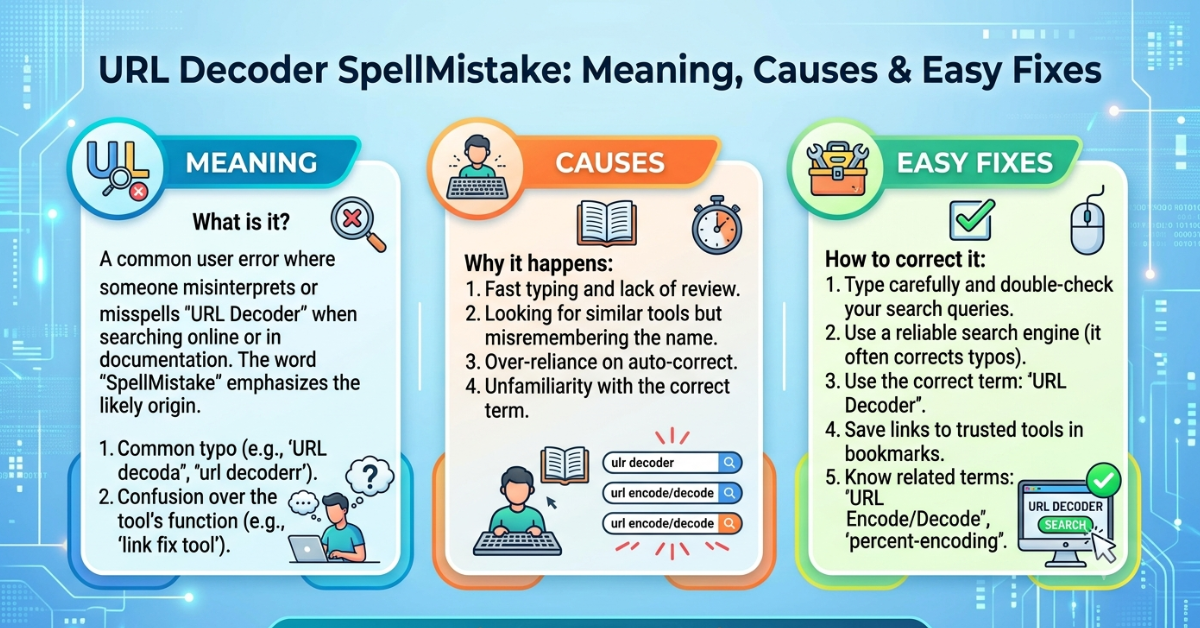
Have you ever searched for a webpage only to encounter the confusing phrase url decoder spellmistake? You’re not alone. Many users come across this term while troubleshooting broken links, decoding URLs, or correcting web addresses that don’t seem to work.
The phrase url decoder spellmistake isn’t an official technical error, but it commonly refers to spelling mistakes or incorrectly formatted text in a URL that prevent proper decoding or interpretation. In this guide, you’ll learn what it means, why it occurs, how URL decoding works, common mistakes people make, and the simplest ways to fix these issues.
What Is URL Decoding?
Before understanding the error, it’s important to know what URL decoding actually means.
A URL (Uniform Resource Locator) is the address used to locate resources on the internet. Since URLs can only contain specific characters safely, special characters are converted into encoded values.
For example:
| Character | Encoded Value |
| Space | %20 |
| @ | %40 |
| # | %23 |
| & | %26 |
URL decoding is the process of converting these encoded values back into their original characters so browsers and applications can correctly interpret the address.
For example:
https://example.com/search?q=hello%20worldbecomes
https://example.com/search?q=hello worldWhat Does “URL Decoder SpellMistake” Mean?
The term url decoder spellmistake generally refers to one of several situations:
- A misspelled URL entered by a user
- Incorrect percent encoding
- Typographical errors during URL decoding
- Invalid encoded characters
- A browser or decoding tool failing because of malformed input
In simple terms, the decoder cannot properly interpret the URL because something is typed incorrectly.
How URL Encoding and Decoding Work
Every time you search online, submit a form, or click a link, browsers often encode certain characters.
Example
Original text:
Best coffee shops near meEncoded URL:
Best%20coffee%20shops%20near%20meDecoded result:
Best coffee shops near meIf one encoded character is misspelled, decoding may fail.
For example:
Correct:
%20Incorrect:
%2ONotice the last character:
- Correct: zero (0)
- Incorrect: capital letter O
This small spelling mistake completely changes the meaning.
Common Causes of URL Decoder SpellMistake
Several issues can trigger decoding problems.
1. Typing Errors
The most common cause is human error.
Examples include:
- Missing letters
- Extra symbols
- Wrong capitalization
- Incorrect numbers
Example:
Correct
https://website.com/profileIncorrect
https://website.com/profiel2. Incorrect Percent Encoding
Every encoded character must follow this format:
%XXwhere XX represents two hexadecimal digits.
Incorrect examples:
%2G
%ZZ
%3X
These cannot be decoded correctly.
3. Copy-and-Paste Mistakes
Sometimes URLs become corrupted while copying them from:
- PDFs
- Emails
- Messaging apps
- Word documents
Hidden spaces or invisible characters can break the URL.
4. Browser Formatting Issues
Occasionally browsers automatically modify URLs, especially when:
- Auto-correct is enabled
- Extensions interfere
- Special characters aren’t supported
5. Manual URL Editing
Developers and users sometimes edit URLs manually.
Even changing a single character can produce decoding errors.
Example:
Correct:
John%20SmithIncorrect:
John20SmithThe missing percent sign changes everything.
Examples of URL Decoder SpellMistakes
Example 1
Correct:
Hello%20WorldIncorrect:
Hello20WorldExample 2
Correct:
email%40example.comIncorrect:
email40example.comExample 3
Correct:
search?q=blue%20carIncorrect:
search?q=blue%2OcarAgain, the letter O replaces zero.
Signs That a URL Contains a Spell Mistake
Look for these warning signs:
- Page not found (404)
- Invalid URL
- Malformed URL
- Bad Request (400)
- Decoding failure
- Unexpected symbols
- Broken hyperlinks
These don’t always mean decoding problems, but spelling mistakes are among the most common causes.
How to Fix URL Decoder SpellMistake
Fortunately, most issues are easy to resolve.
Double-Check the URL
Read every character carefully.
Pay attention to:
- Zero (0) vs O
- One (1) vs lowercase l
- Hyphen (-) vs underscore (_)
Small differences matter.
Verify Percent Encoding
Ensure every encoded character follows:
%XXExamples:
Correct:
%20
%40
%23
Incorrect:
20
40
2G
Use Trusted URL Decoder Tools
Many online tools automatically detect encoding issues and convert URLs correctly.
These tools help identify:
- Invalid encoding
- Missing symbols
- Incorrect hexadecimal values
- Hidden formatting problems
Avoid Editing Encoded URLs
If a URL is already encoded, avoid changing it manually unless necessary.
One misplaced character can invalidate the entire address.
Copy URLs Carefully
Instead of typing long URLs manually:
- Copy directly from the source
- Avoid adding spaces
- Remove quotation marks
- Check for line breaks
Why URL Accuracy Matters
A correctly formatted URL benefits everyone.
Better User Experience
Visitors reach the intended page without confusion.
Improved SEO
Search engines prefer clean, readable URLs.
Proper formatting also reduces crawl errors.
Reliable Data Sharing
Encoded URLs preserve information accurately when:
- Sharing search results
- Sending email links
- Passing query parameters
- Integrating APIs
URL Encoding vs URL Decoding
| URL Encoding | URL Decoding |
| Converts characters into encoded format | Converts encoded values back into readable text |
| Used before transmission | Used after receiving the URL |
| Protects special characters | Restores original characters |
| Example: Space → %20 | Example: %20 → Space |
Best Practices to Avoid URL Decoder SpellMistake
Follow these simple habits:
- Never guess encoded values.
- Proofread URLs before sharing.
- Avoid unnecessary manual edits.
- Use standard UTF-8 encoding.
- Test URLs before publishing.
- Validate links in websites and applications.
- Keep URLs clean and readable.
- Use trusted encoding tools when needed.
Real-World Situations Where URL Decoding Matters
URL decoding isn’t limited to developers. It plays an important role in many everyday scenarios.
Digital Marketing
Marketing campaigns often include tracking parameters in URLs. Incorrect encoding can break campaign links and lead to inaccurate analytics.
Web Development
Developers rely on proper URL encoding to pass data safely between browsers and servers. Even a small typo can prevent applications from functioning correctly.
Online Forms
Information entered into search boxes or forms is frequently encoded before being sent. Proper decoding ensures names, addresses, and search queries display as intended.
APIs and Software Integration
Applications exchange information through URLs. Accurate encoding and decoding prevent data corruption and communication errors between systems.
Key Takeaways
- URL decoder spellmistake usually refers to spelling or formatting errors that prevent a URL from being decoded correctly.
- URL decoding converts encoded characters back into readable text.
- Minor mistakes, such as replacing a zero with the letter “O,” can cause decoding failures.
- Carefully checking URLs and using reliable decoding tools can resolve most issues.
- Proper URL formatting improves usability, search engine optimization, and data accuracy.
Frequently Asked Questions
What is a URL decoder spellmistake?
A url decoder spellmistake generally refers to a typo or formatting error in an encoded URL that prevents it from being decoded correctly. It is a descriptive phrase rather than an official technical error.
Why won’t my encoded URL decode properly?
Common reasons include incorrect percent encoding, missing symbols, invalid hexadecimal values, or simple typing mistakes. Even one incorrect character can stop the decoding process.
Can a spelling mistake break a URL?
Yes. A single misplaced character can lead to a broken link, an error page, or failed URL decoding, especially when encoded values are involved.
What is the difference between URL encoding and decoding?
Encoding converts special characters into a safe format for transmission, while decoding restores those encoded values to their original readable form.
How can I prevent URL decoding errors?
Double-check URLs before sharing, avoid editing encoded values manually, use trusted encoding or decoding tools, and verify that all percent-encoded sequences follow the correct format.
Is URL decoding important for SEO?
Yes. Properly formatted URLs improve crawlability, reduce errors, enhance user experience, and help search engines understand website structure more effectively.
Conclusion
Although url decoder spellmistake is not an official technical term, it describes a common problem that many users encounter when URLs contain spelling, formatting, or encoding errors. Understanding how URL encoding and decoding work makes it much easier to identify these issues and fix them quickly.
Whether you’re a website owner, developer, marketer, or everyday internet user, paying attention to URL accuracy can save time, prevent broken links, and improve the overall browsing experience. Apply the best practices outlined in this guide to ensure your URLs remain clean, functional, and easy to interpret.
