
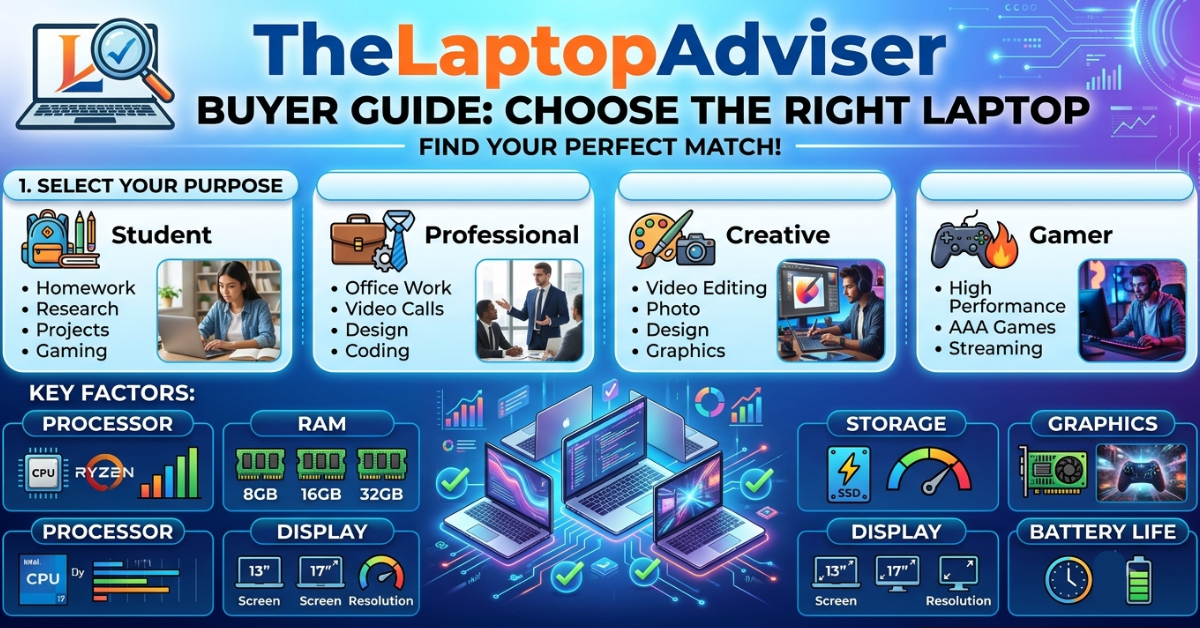
The thelaptopadviser buyer guide is a resource designed to help consumers understand laptop buying decisions through practical advice, comparisons, and easy-to-follow recommendations.
Rather than simply listing the newest devices, a quality buyer guide focuses on answering questions like:
- Which laptop fits your budget?
- How much performance do you actually need?
- Which specifications matter most?
- What features are worth paying extra for?
- Which laptops offer the best long-term value?
Instead of encouraging buyers to purchase the most expensive model, the guide emphasizes choosing the right laptop for individual needs.
Why Laptop Buying Has Become More Complicated
Modern laptops offer countless combinations of hardware and features.
Today’s buyers must choose between:
- Windows laptops
- macOS devices
- Chromebooks
- Gaming laptops
- Ultrabooks
- 2-in-1 convertible laptops
- Business notebooks
- Creator-focused workstations
Each category serves different purposes, making expert guidance increasingly valuable.
Understanding Your Laptop Needs Before Shopping
One of the biggest lessons from any effective buyer guide is identifying your actual requirements before comparing specifications.
Everyday Users
If your activities include:
- Web browsing
- Watching videos
- Microsoft Office
- Video calls
You don’t necessarily need premium hardware.
Focus on:
- Reliable battery life
- Comfortable keyboard
- Full HD display
- Fast SSD storage
Students
Students often prioritize portability and affordability.
Recommended features include:
- Lightweight design
- Long battery life
- Durable construction
- At least 16GB RAM
- SSD storage
- Reliable webcam
These features support note-taking, online classes, research, and assignments.
Professionals
Business users typically require:
- Strong multitasking performance
- Security features
- Comfortable keyboard
- High-quality display
- Long battery life
- USB-C and HDMI connectivity
Professionals who frequently travel should also consider weight and durability.
Gamers
Gaming laptops demand significantly more powerful hardware.
Key components include:
- Dedicated GPU
- High-refresh-rate display
- Advanced cooling system
- Modern processor
- Fast SSD
- Adequate RAM
Gaming performance depends more on the graphics card than almost any other component.
Content Creators
Photo editors, video editors, designers, and 3D artists should prioritize:
- Color-accurate displays
- Powerful CPU
- Dedicated graphics
- Large SSD
- Expandable storage
- High RAM capacity
Creative workloads require substantially more computing power than everyday tasks.
Key Laptop Specifications Explained
One reason the thelaptopadviser buyer guide is useful is that it translates technical specifications into practical buying advice.
Processor (CPU)
The processor acts as the laptop’s brain.
Popular options include:
- Intel Core i3
- Intel Core i5
- Intel Core i7
- Intel Core i9
- AMD Ryzen 3
- AMD Ryzen 5
- AMD Ryzen 7
- AMD Ryzen 9
General recommendations:
| Usage | Suggested Processor |
| Basic tasks | Core i3 / Ryzen 3 |
| Students | Core i5 / Ryzen 5 |
| Professionals | Core i7 / Ryzen 7 |
| Heavy editing | Core i9 / Ryzen 9 |
RAM
RAM determines how smoothly your laptop multitasks.
Recommended amounts:
- 8GB – Basic users
- 16GB – Most users
- 32GB – Creators
- 64GB+ – Professional workloads
Today, 16GB is becoming the ideal balance for most buyers.
Storage
Solid State Drives (SSD) are now the standard.
Options include:
- 256GB SSD
- 512GB SSD
- 1TB SSD
- 2TB SSD
Compared to traditional hard drives, SSDs provide:
- Faster boot times
- Faster software loading
- Better reliability
- Lower power consumption
Display Quality
Display quality affects everyday comfort more than many buyers realize.
Look for:
- Full HD (1920×1080) minimum
- IPS panel
- Good brightness
- Anti-glare coating
- Accurate colors
Higher resolutions benefit photographers, designers, and video editors.
Battery Life
Manufacturers often advertise ideal battery life under controlled conditions.
Real-world battery life depends on:
- Screen brightness
- Processor efficiency
- Running applications
- Display resolution
- Graphics usage
Aim for laptops offering at least 8–10 hours of practical use.
Graphics Card
Graphics are available in two forms.
Integrated Graphics
Suitable for:
- Browsing
- Office work
- Streaming
- Casual editing
Dedicated Graphics
Better for:
- Gaming
- Video editing
- 3D rendering
- Engineering software
- Animation
Choosing a Laptop by Budget
Budget Laptops
Ideal for:
- Students
- Home users
- Office work
Expect:
- Reliable performance
- SSD storage
- Basic graphics
- Everyday productivity
Mid-Range Laptops
These provide the best balance between price and performance.
Common features include:
- Better displays
- Faster processors
- 16GB RAM
- Improved build quality
- Longer battery life
For many buyers, this category offers the best value.
Premium Laptops
Premium devices focus on:
- Exceptional displays
- Premium materials
- Powerful hardware
- Excellent keyboards
- Long-term durability
They suit professionals who depend on their laptops daily.
Features Worth Paying For
Some upgrades genuinely improve the ownership experience.
Consider investing in:
- Backlit keyboard
- Fingerprint reader
- Fast charging
- Thunderbolt or USB4 ports
- Wi-Fi 6 or Wi-Fi 7 support
- High-quality webcam
- Better speakers
These features enhance daily usability rather than just boosting benchmark scores.
Common Laptop Buying Mistakes
Many buyers regret their purchase because they focus on marketing instead of practical needs.
Avoid these mistakes:
- Buying more power than necessary
- Ignoring battery life
- Choosing too little storage
- Overlooking display quality
- Forgetting portability
- Ignoring upgrade options
- Buying based only on appearance
A balanced decision usually leads to greater long-term satisfaction.
How to Compare Two Laptops Effectively
Instead of comparing dozens of specifications, evaluate these categories:
- Processor generation
- RAM capacity
- SSD size
- Display quality
- Battery life
- Weight
- Build quality
- Warranty
- Connectivity
- Overall value
Looking at the complete package is more useful than focusing on one impressive specification.
Practical Laptop Buying Tips
Before making your purchase:
- Define your primary use.
- Set a realistic budget.
- Prioritize performance over flashy design.
- Read multiple reviews instead of relying on one opinion.
- Think about future needs.
- Consider repairability and upgrade options.
- Buy slightly above your minimum requirements if possible.
Planning ahead can extend the useful life of your laptop by several years.
Who Can Benefit from the TheLaptopAdviser Buyer Guide?
The guide is particularly useful for:
- First-time laptop buyers
- Students
- Parents purchasing family computers
- Business professionals
- Remote workers
- Freelancers
- Gamers
- Creative professionals
- Small business owners
Regardless of experience level, structured buying advice helps simplify a complex purchasing decision.
Key Takeaways
- The thelaptopadviser buyer guide simplifies laptop shopping by focusing on practical needs rather than marketing claims.
- Your intended use should determine your laptop choice.
- Prioritize processor, RAM, SSD storage, battery life, and display quality.
- Mid-range laptops often offer the best balance between cost and performance.
- Avoid paying for features you won’t use regularly.
- Comparing overall value is more effective than comparing individual specifications.
Frequently Asked Questions
What is the thelaptopadviser buyer guide?
The thelaptopadviser buyer guide is a resource that helps buyers understand laptop specifications, compare models, and choose devices based on their needs rather than advertising claims.
Is the thelaptopadviser buyer guide useful for beginners?
Yes. It explains technical concepts in simple language, making it easier for first-time buyers to understand processors, RAM, storage, graphics, and other important features.
What specifications matter most when buying a laptop?
The most important specifications include the processor, RAM, SSD storage, battery life, display quality, build quality, and overall portability. The right combination depends on how you plan to use the laptop.
Should I buy a gaming laptop for everyday use?
Gaming laptops can handle everyday tasks easily, but they are often heavier, more expensive, and have shorter battery life. Unless you need the graphics power, a standard productivity laptop is usually a better choice.
How often should I replace my laptop?
Most quality laptops remain useful for five to seven years, depending on hardware, maintenance, and changing software requirements. Buying slightly better specifications today can extend the laptop’s lifespan.
Is spending more always worth it?
Not necessarily. The best laptop is the one that matches your workload and budget. Paying extra only makes sense if the additional features provide meaningful benefits for your daily use.
Conclusion
Choosing the right laptop doesn’t have to be confusing. With a thoughtful approach and the insights provided by the thelaptopadviser buyer guide, you can focus on what truly matters instead of getting distracted by technical jargon or flashy marketing.
By understanding your personal requirements, comparing meaningful specifications, setting a realistic budget, and avoiding common buying mistakes, you’ll be far more likely to invest in a laptop that delivers excellent performance and lasting value. Use these principles whenever you’re shopping for a new device, and you’ll make a decision that’s both informed and future-ready.
