
Have you ever searched for a strange code like python 54axhg5 and wondered whether it’s a programming tool, a hidden Python feature, or something more technical? You’re not alone. Cryptic terms like this often appear in search results, software logs, repositories, or online discussions, leaving many users confused.
This guide explores everything currently known about python 54axhg5, explains what it could represent, discusses possible use cases, highlights security considerations, and shows you how to investigate similar identifiers safely. Whether you’re a beginner learning Python or an experienced developer encountering unfamiliar strings, this article will help you separate facts from speculation.
What Is Python 54axhg5?
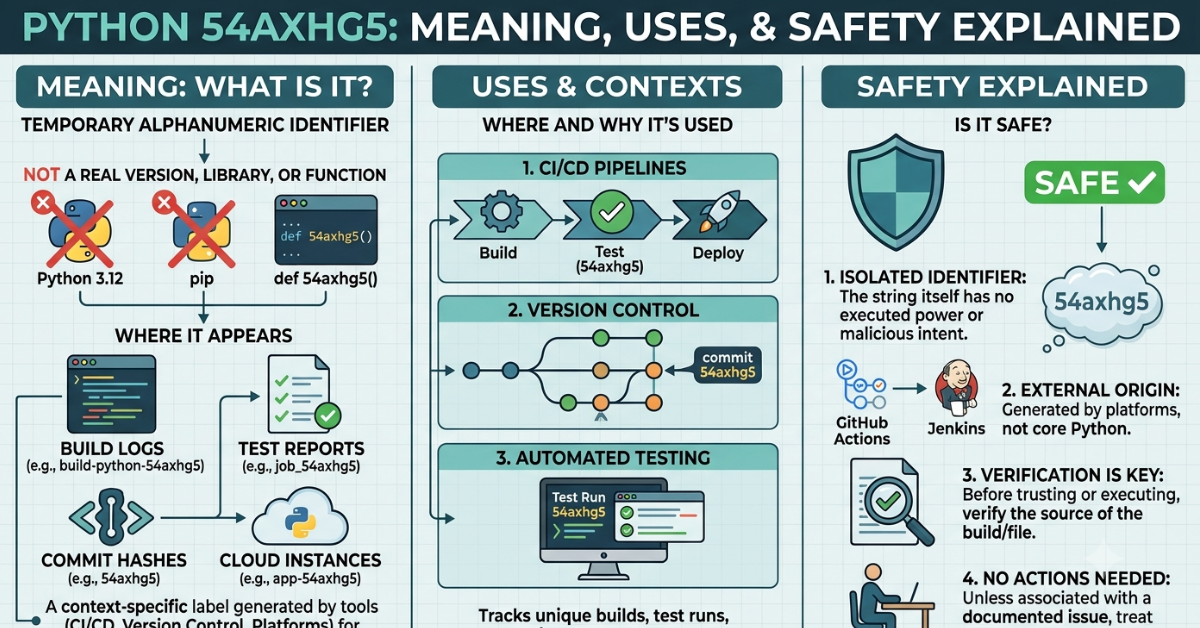
At present, python 54axhg5 is not a recognized Python language feature, official module, standard library package, or widely documented framework.
Instead, it appears to be an alphanumeric identifier that may have different meanings depending on where it is encountered.
Possible interpretations include:
- An internal project identifier
- A randomly generated filename
- A software build code
- A development branch name
- A temporary token
- A testing dataset identifier
- An automatically generated package label
- A custom script name created by a developer
Unlike well-known Python technologies such as Django, Flask, NumPy, or Pandas, there is no official documentation identifying “54axhg5” as part of the Python ecosystem.
Why Are People Searching for Python 54axhg5?
Several reasons could explain the growing curiosity around this unusual term.
Encountering It in Software
Some users discover the string while:
- Installing applications
- Running automation scripts
- Reading error logs
- Reviewing development files
- Working with cloud deployments
Random-looking identifiers are common in modern software systems.
Appearing in Search Results
Sometimes search engines index:
- Temporary development pages
- Cached repositories
- AI-generated content
- Testing environments
As a result, obscure identifiers may unexpectedly appear in search suggestions.
Internal Project References
Large software companies often assign internal labels to:
- Development builds
- Experimental features
- Testing environments
- Quality assurance versions
If a developer accidentally publishes documentation containing these identifiers, they may become searchable.
Could Python 54axhg5 Be Malware?
Not necessarily.
The name alone does not indicate malware.
However, unknown scripts should always be handled carefully.
Consider these questions:
- Where did you find it?
- Was it downloaded automatically?
- Did it come from a trusted source?
- Is it part of a legitimate application?
- Does it request unusual permissions?
Unknown Python files deserve investigation before execution.
Common Places Where Similar Identifiers Appear
Many developers regularly encounter randomly generated strings.
Examples include:
| Environment | Purpose |
| Git repositories | Temporary branch names |
| Python virtual environments | Auto-generated folders |
| CI/CD pipelines | Build identifiers |
| Cloud platforms | Deployment IDs |
| Docker containers | Image tags |
| Machine learning projects | Experiment tracking IDs |
| APIs | Session identifiers |
| Databases | Generated record keys |
The format “54axhg5” resembles many automatically generated identifiers.
Is Python 54axhg5 an Official Python Package?
There is currently no evidence that python 54axhg5 is an officially recognized Python package.
Official Python packages are usually distributed through package managers and have:
- Documentation
- Version history
- Developer information
- Installation instructions
- Community support
An isolated identifier without documentation should not automatically be assumed to be a legitimate package.
How to Investigate Unknown Python Identifiers
If you encounter an unfamiliar identifier, follow a systematic approach.
1. Check the File Extension
Determine whether it is:
- .py
- .pyw
- .pyc
- .json
- .yaml
- .txt
- Configuration file
The extension provides important clues.
2. Inspect the Source
Open the file in a text editor.
Look for:
- Comments
- Function names
- Imports
- Author information
- Documentation strings
Avoid executing the code before reviewing it.
3. Search Within the Project
Search the project directory for the identifier.
You may discover:
- Configuration references
- Environment variables
- Documentation
- Build scripts
Often, the mysterious string is referenced elsewhere.
4. Examine Version Control History
If the project uses Git, inspect:
- Commit history
- Branch names
- Pull requests
The identifier may correspond to an experimental feature.
5. Review Dependencies
Sometimes identifiers belong to:
- Third-party libraries
- Plugins
- Automation tools
- Deployment scripts
Dependency files can provide context.
Could It Be Generated Automatically?
Yes.
Many Python applications automatically generate identifiers for organizational purposes.
Examples include:
- Cache folders
- Temporary sessions
- Build numbers
- Job IDs
- Backup names
- Experiment identifiers
- Container names
Random combinations of letters and numbers help prevent naming conflicts.
Security Best Practices
Whenever you discover unfamiliar Python files or identifiers, follow these precautions.
Do
- Verify the source.
- Read the code before running it.
- Scan downloaded files.
- Keep Python updated.
- Use virtual environments.
- Install packages only from trusted sources.
Avoid
- Running unknown scripts immediately.
- Granting administrator permissions unnecessarily.
- Ignoring security warnings.
- Downloading files from suspicious websites.
- Disabling antivirus software.
Good security habits reduce unnecessary risk.
How Developers Name Internal Projects
Many software teams intentionally use short identifiers during development.
Examples include:
- Alpha builds
- Feature branches
- Ticket numbers
- Prototype IDs
- Test releases
- Automation tasks
A name like “54axhg5” fits the style of an internal development label rather than a public product.
Python Naming Conventions Compared
Understanding common Python naming styles helps identify unusual entries.
| Type | Example |
| Module | data_processing |
| Package | requests |
| Class | DataLoader |
| Function | calculate_total() |
| Variable | user_name |
| Temporary identifier | 54axhg5 |
| Build label | build_2026_07 |
| Session token | a8f9k23m |
The unusual format makes it unlikely that “54axhg5” is intended as a user-facing Python module.
Real-World Scenarios
Here are a few situations where you might encounter a similar identifier.
Software Installation
An installer extracts temporary files with randomized names.
Machine Learning Experiment
Training jobs automatically generate experiment IDs for tracking.
Cloud Deployment
Deployment systems assign unique identifiers to applications.
Development Testing
Developers create temporary scripts using generated names before final release.
In all these cases, the identifier itself is simply a label rather than a programming feature.
Practical Tips When Encountering Unknown Python Codes
If you come across python 54axhg5, remember these recommendations:
- Stay calm; unusual identifiers are common.
- Determine where the code originated.
- Check whether it belongs to a trusted project.
- Read documentation if available.
- Ask the project maintainer if necessary.
- Avoid making assumptions based solely on the name.
Context is more important than the identifier itself.
Key Takeaways
- Python 54axhg5 is not currently recognized as an official Python language feature or standard package.
- It most likely represents an internal identifier, temporary label, or autogenerated code.
- Unknown Python scripts should always be inspected before execution.
- Random alphanumeric names are common in software development.
- Understanding the context helps determine whether the identifier is harmless or requires further investigation.
Frequently Asked Questions
What is python 54axhg5?
Python 54axhg5 appears to be an unidentified alphanumeric label rather than an official Python library or language feature. Its meaning depends on the software or project where it was found.
Is python 54axhg5 safe?
The identifier itself is neither safe nor unsafe. Safety depends on the associated file or application. Always verify the source before running unknown Python code.
Can I install python 54axhg5?
There is no evidence that python 54axhg5 is an official installable package. Confirm its purpose before attempting any installation.
Why do Python projects use random names?
Developers and automated systems often generate unique identifiers for builds, temporary files, experiments, deployments, and testing to avoid naming conflicts.
How can I identify an unknown Python script?
Inspect the source code, review project documentation, examine dependencies, and verify where the file originated before executing it.
Does python 54axhg5 belong to Python itself?
No publicly available information indicates that python 54axhg5 is part of the official Python language, its standard library, or its core development tools.
Conclusion
Although python 54axhg5 may seem mysterious at first glance, there is no evidence that it represents an official Python feature, package, or framework. In most cases, identifiers like this are autogenerated labels, internal development references, or temporary project names rather than technologies users interact with directly.
When you encounter unfamiliar Python-related strings, focus on their context instead of the name alone. Reviewing the source, verifying the origin, and following good security practices will help you understand what the identifier represents while keeping your system safe. As you continue learning Python, developing the habit of investigating unknown code thoughtfully will make you a more confident and security-conscious developer.
