
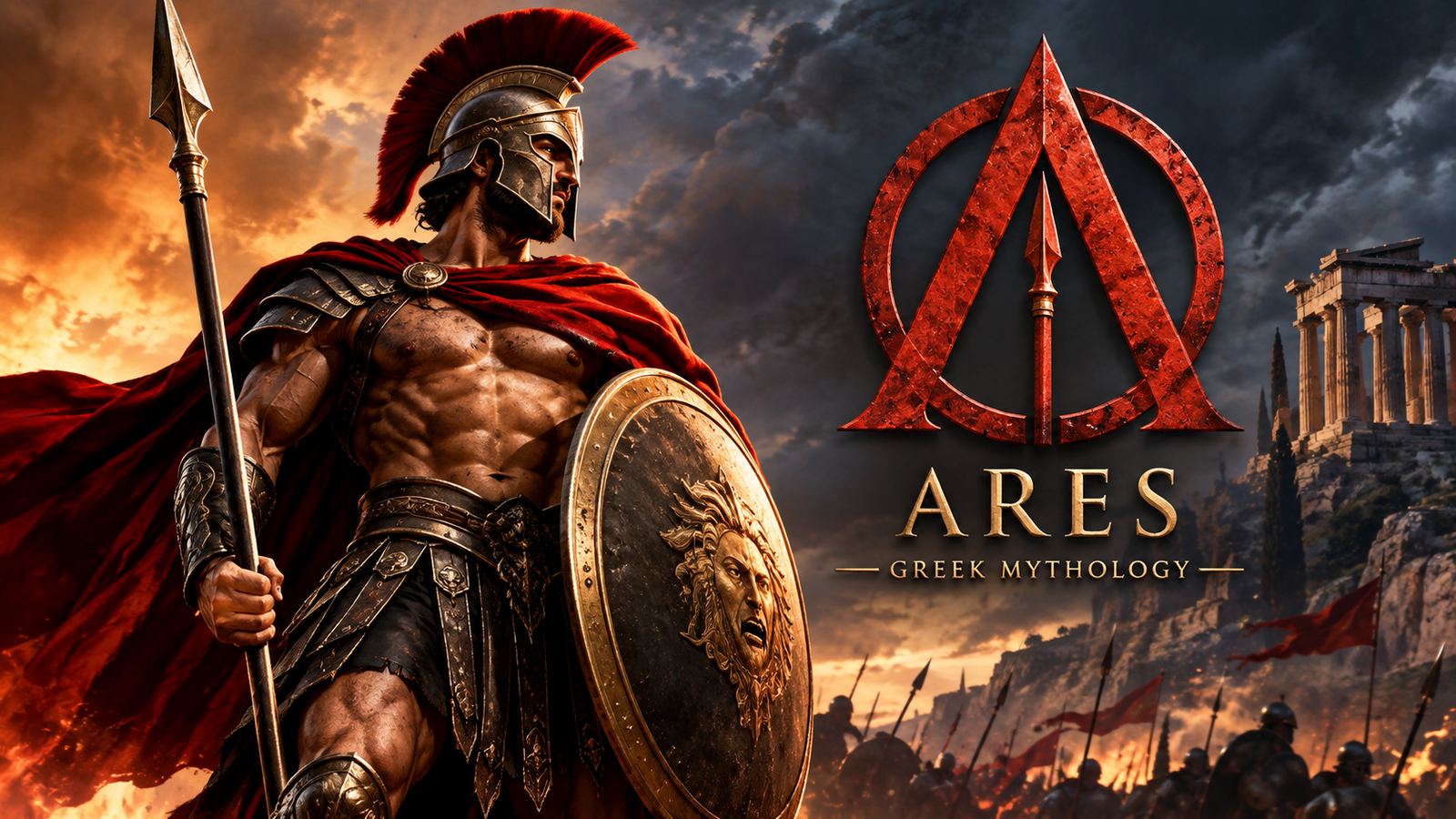
When people search for the Ares symbol Greek mythology, they are often looking for more than a simple image or emblem. Ares was one of the most important gods in ancient Greek mythology, and his symbols reflected his connection with war, violence, courage, battle, and the chaotic side of conflict.
Unlike Athena, who represented strategy and disciplined warfare, Ares was associated more strongly with the brutal and emotional side of battle. His symbols, animals, weapons, and armor all help explain how the ancient Greeks viewed his character.
Understanding the symbols of Ares also gives us a better idea of how Greek mythology separated different aspects of war. Ares was not simply a god who carried a weapon. His entire identity was connected with the intensity, danger, and destruction of combat.
Who Was Ares in Greek Mythology?
Ares was the Greek god associated with war and battle. He was generally described as the son of Zeus and Hera, making him one of the major Olympian gods. His Roman counterpart was Mars, although the two gods developed different cultural identities and reputations.
In Greek mythology, Ares represented the violent and uncontrolled aspects of warfare. He was connected with bloodshed, fighting, anger, and the excitement of battle. This made him different from Athena, who was also connected with warfare but represented wisdom, planning, and military strategy.
Ares appears in several famous Greek myths. His stories often show him as powerful and aggressive, but they also reveal that strength alone did not always guarantee victory. His character could be impulsive, emotional, and vulnerable despite his status as a god.
What Is the Main Ares Symbol?
There is not one single official Ares symbol in Greek mythology that works exactly like a modern logo. Instead, several objects and images are traditionally associated with him.
The most recognizable symbols connected with Ares include the spear, sword, shield, helmet, armor, and chariot. These objects represent his role as a warrior and his connection with armed conflict.
Among these, the spear is particularly important. Spears were common weapons in ancient Greek warfare, and the weapon naturally became associated with a god whose identity centered on battle. Ares is frequently represented as an armed warrior carrying or using weapons.
The Spear as a Symbol of Ares
The spear is one of the clearest symbols connected with Ares. In ancient warfare, the spear was an important weapon used by Greek soldiers, so its association with the god of war is easy to understand.
The spear can represent aggression, combat, strength, and direct confrontation. These qualities fit the traditional image of Ares as a deity connected with the physical and violent side of warfare.
In artistic representations, Ares may appear equipped with a spear while wearing armor. The weapon emphasizes his identity as a warrior rather than a ruler or philosopher. It also helps distinguish him from gods whose symbols were connected with completely different areas of life.
The Sword and Ares
The sword is another important object associated with Ares. Like the spear, it represents armed combat and the dangers of close fighting.
A sword carries a slightly different visual meaning from a spear. A spear can suggest organized battlefield combat, while a sword is often associated with personal confrontation and close-range fighting. Both fit the aggressive nature traditionally attributed to Ares.
Modern images of Ares often use a sword because it is immediately recognizable as a weapon. However, it is worth remembering that modern artistic representations do not always reproduce one fixed ancient symbol. Artists have interpreted Ares in different ways throughout history.
The Shield and Helmet of Ares
A shield is another common symbol associated with Ares. Shields were essential pieces of equipment for ancient Greek warriors, providing protection while soldiers fought in close formations.
For Ares, the shield can represent the battlefield itself and the dangers faced by warriors. It also emphasizes that the god is presented as a fully equipped fighter rather than simply an abstract representation of violence.
The helmet is similarly important. Ancient Greek warriors commonly wore helmets for protection, and the helmet became a strong visual sign of military identity. When Ares is shown wearing a helmet, viewers can immediately recognize his connection with warfare.
Ares and His Armor
Armor is closely connected with the traditional image of Ares. In Greek art, he can be portrayed as a powerful warrior wearing military equipment.
Armor represents preparation for battle, physical protection, and the warrior’s role. It also gives Ares a distinct appearance among the Olympian gods.
At the same time, Ares was not simply admired as an ideal soldier. Greek stories sometimes portray him as a complicated figure whose enthusiasm for violence could create problems. His armor therefore represents both military power and the dangerous nature of warfare.
The Chariot of Ares
The chariot is another important image connected with Ares. In ancient Greek mythology and art, gods and heroes could be associated with chariots, which were symbols of movement, power, and warfare.
Ares is sometimes described as traveling into battle in a chariot. The image fits his role as a war deity and creates a dramatic picture of him entering a battlefield.
The chariot also connects Ares with the wider military world of ancient Greek culture. It shows that his symbolism was not limited to individual weapons. His imagery could represent the entire spectacle and movement of war.
Which Animals Were Associated With Ares?
Several animals are traditionally associated with Ares, including the dog, boar, and vulture. These animals appear in discussions of Ares symbolism because they reflect different aspects of his mythology and character.
The boar, for example, was associated with aggression, strength, and dangerous behavior. Its fierce reputation made it an appropriate animal for a deity connected with violent conflict.
Dogs and vultures also appear in traditions and artistic associations involving Ares. Vultures in particular have a natural connection with battlefields because they feed on dead animals. This creates a strong symbolic connection with death and the aftermath of war.
The Vulture as a Symbol of War
The vulture has a darker symbolic meaning when connected with Ares. Unlike weapons and armor, which represent the act of fighting, the vulture can represent what remains after battle.
Ancient warfare brought death and destruction, and scavenging birds were naturally connected with battlefields. The vulture therefore fits the darker side of Ares’s mythology.
This symbolism helps explain why Ares should not be understood simply as a heroic warrior figure. His mythology also reflects the suffering and destruction that can accompany warfare.
The Boar and Ares Symbolism
The boar is another animal associated with Ares. In Greek mythology, wild boars were often portrayed as dangerous and powerful creatures.
The animal’s aggressive behavior made it a fitting symbol for a god associated with uncontrolled violence and battle. The boar could represent physical strength, anger, and danger.
The association also fits the broader way ancient Greek mythology used animals. Gods were often connected with animals that reflected their characteristics, powers, stories, or religious traditions.
Ares and the Difference Between War and Wisdom
One of the most interesting parts of Ares symbolism is the difference between Ares and Athena. Both gods were connected with warfare, but Greek mythology often presented them in very different ways.
Ares represented the violent and emotional side of conflict. Athena, meanwhile, was strongly associated with strategy, intelligence, planning, and disciplined warfare.
This distinction is important when studying the Ares symbol Greek mythology. His weapons do not simply represent military success. They can also represent the destructive side of battle and the emotional force that drives people into conflict.
Ares Symbol vs. Mars Symbol
Ares and Mars are often treated as the same god because Mars was the Roman equivalent of Ares. However, their cultural roles were not completely identical.
Ares had a relatively complicated reputation in Greek mythology and was often connected with the frightening and destructive nature of war. Mars became especially important in Roman culture and developed a stronger connection with Roman military identity and the state.
As a result, modern symbols associated with Mars should not automatically be described as ancient Greek symbols of Ares. The two traditions overlap, but they should still be understood in their own historical contexts.
Why Is the Ares Symbol Still Popular Today?
Ares remains popular in modern culture because his imagery is easy to recognize. A warrior carrying a spear or sword, wearing a helmet and armor, immediately communicates ideas about battle and strength.
Movies, video games, books, artwork, tattoos, and fantasy designs frequently use Ares-inspired imagery. These modern interpretations sometimes combine several traditional symbols into one dramatic design.
However, a modern Ares logo or tattoo does not necessarily represent an ancient Greek religious symbol. It may simply be a contemporary artistic interpretation inspired by the mythology.
What Does the Ares Symbol Mean?
The meaning of an Ares symbol depends on which element is being used. A spear can represent warfare and aggression, while a shield can suggest battle and protection. A helmet can represent the warrior, while a sword can symbolize armed combat.
The animals connected with Ares add another layer of meaning. The boar can suggest aggression and strength, while the vulture can represent death and the aftermath of conflict.
Taken together, these symbols create a picture of Ares as a god associated with the harsher side of warfare. His mythology is not only about victory. It also reflects violence, anger, danger, and destruction.
Final Thoughts on the Ares Symbol Greek Mythology
The Ares symbol Greek mythology is best understood as a collection of traditional images rather than one official symbol. His most recognizable associations include the spear, sword, shield, helmet, armor, and chariot, along with animals such as the boar, dog, and vulture.
Each symbol reveals something about Ares and his role in Greek mythology. Weapons represent combat, armor represents the warrior, and animals can reflect aggression or the darker consequences of war.
Ares remains an interesting figure because Greek mythology did not present warfare as a simple idea. Through Ares, the ancient Greeks explored the anger, violence, excitement, danger, and destruction associated with battle. His symbols continue to appear in modern art and popular culture because these visual ideas remain easy to recognize and understand.
