
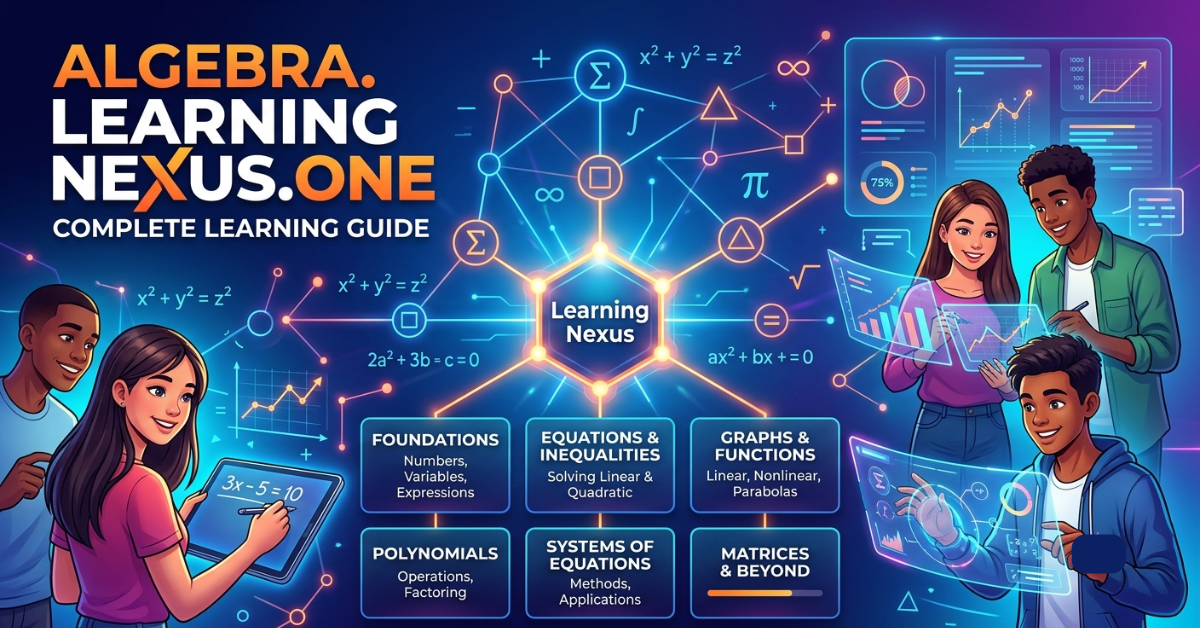
Have you ever wished algebra could feel less confusing and more practical? Whether you’re a student preparing for exams, a parent supporting your child’s education, or someone revisiting mathematics after years, finding the right learning platform can make all the difference.
Algebra.Learning Nexus.One has attracted attention as an online learning resource focused on making algebra concepts more accessible and structured. While information about the platform may vary depending on updates and implementations, its goal is centered around helping learners strengthen their mathematical foundation through organized educational content.
In this guide, you’ll discover what Algebra.Learning Nexus.One is, how it works, its potential features, benefits, learning strategies, and practical tips to maximize your success.
What Is Algebra.Learning Nexus.One?
Algebra.Learning Nexus.One refers to an educational platform or online learning environment designed to support algebra education. Rather than relying solely on textbooks, it brings mathematical learning into a digital space where students can study concepts interactively.
The platform aims to simplify core algebra topics through structured lessons, practice exercises, and guided learning paths.
Its primary audience may include:
- Middle school students
- High school learners
- College beginners
- Adult learners refreshing math skills
- Teachers looking for supplementary resources
- Parents assisting students at home
The overall objective is to build confidence in algebra while encouraging consistent practice.
Why Algebra Matters
Before exploring the platform itself, it’s important to understand why algebra remains one of the most valuable branches of mathematics.
Algebra develops logical reasoning and problem-solving abilities that extend well beyond the classroom.
Students use algebra in:
- Science
- Engineering
- Economics
- Computer programming
- Data analysis
- Architecture
- Finance
- Artificial intelligence
- Business decision-making
Mastering algebra also makes advanced mathematics significantly easier.
Key Features of Algebra.Learning Nexus.One
Although specific implementations may differ, educational platforms with this focus commonly include several essential learning tools.
Interactive Lessons
Instead of reading lengthy explanations, learners progress through organized lessons that introduce concepts step by step.
Topics often include:
- Variables
- Expressions
- Equations
- Inequalities
- Functions
- Graphing
- Polynomials
- Factoring
- Quadratic equations
Each lesson typically builds upon previously learned material.
Practice Problems
Practice is essential in mathematics.
Students generally benefit from:
- Multiple-choice questions
- Fill-in-the-blank exercises
- Equation solving
- Word problems
- Real-life applications
- Progressive difficulty levels
Repeated exposure strengthens long-term understanding.
Step-by-Step Solutions
One of the biggest challenges in learning algebra is understanding why an answer is correct.
Quality learning platforms often provide:
- Detailed explanations
- Intermediate solution steps
- Common mistake identification
- Alternative solving methods
This encourages conceptual learning instead of memorization.
Progress Tracking
Learning becomes more motivating when progress is visible.
Tracking features may include:
- Lesson completion
- Quiz scores
- Accuracy percentages
- Performance history
- Skill mastery indicators
These insights help learners identify strengths and areas needing improvement.
Personalized Learning
Modern educational technology increasingly adapts content based on learner performance.
Personalized learning may offer:
- Customized practice
- Adaptive difficulty
- Recommended review topics
- Individual learning pathways
This creates a more efficient study experience.
Core Algebra Topics You Can Learn
A comprehensive algebra platform generally covers the full learning journey.
Understanding Variables
Variables represent unknown values.
Example:
x + 5 = 12
Students learn how to isolate variables and determine their values.
Algebraic Expressions
Expressions combine numbers, variables, and operations.
Examples include:
- 3x + 7
- 5a − 4
- 2y² + 9
Students learn simplification and evaluation techniques.
Solving Linear Equations
Linear equations form the foundation of algebra.
Example:
2x + 6 = 18
Learners practice balancing equations while maintaining equality.
Graphing Functions
Visual learning becomes important as students progress.
Topics include:
- Coordinate planes
- Slope
- Intercepts
- Linear graphs
- Function notation
Graph interpretation strengthens mathematical reasoning.
Quadratic Equations
More advanced lessons introduce:
- Factoring
- Completing the square
- Quadratic formula
- Graphing parabolas
These concepts prepare students for higher-level mathematics.
Benefits of Using Algebra.Learning Nexus.One
Learn at Your Own Pace
Students can revisit lessons whenever necessary.
Unlike classroom instruction, there is no pressure to keep up with others.
Builds Confidence
Regular practice gradually reduces math anxiety.
Each completed lesson contributes to stronger problem-solving confidence.
Flexible Learning
Digital learning allows students to study:
- At home
- During travel
- After school
- On weekends
- During revision sessions
Flexibility improves learning consistency.
Encourages Independent Learning
Instead of depending entirely on teachers, students develop self-learning habits.
These habits benefit future academic success.
Immediate Feedback
Quick feedback allows learners to correct misunderstandings before they become long-term habits.
This leads to more effective learning outcomes.
Who Can Benefit Most?
Algebra.Learning Nexus.One can be valuable for a wide range of learners.
Students
- Homework support
- Exam preparation
- Concept revision
Teachers
- Supplement classroom instruction
- Assign practice exercises
- Monitor student progress
Parents
- Assist children with homework
- Encourage consistent study routines
Adult Learners
Many adults revisit algebra for:
- College entrance exams
- Career advancement
- Professional certifications
Effective Strategies for Learning Algebra
Simply using a learning platform isn’t enough.
Success depends on study habits.
Practice Every Day
Even 20–30 minutes of daily practice is more effective than one long weekly session.
Understand the Logic
Avoid memorizing formulas without understanding the reasoning behind them.
Conceptual learning leads to long-term retention.
Review Mistakes
Every incorrect answer is a learning opportunity.
Keep a notebook of:
- Common errors
- Difficult concepts
- Frequently forgotten formulas
Work Through Word Problems
Word problems strengthen analytical thinking.
Practice translating real-world situations into mathematical equations.
Stay Consistent
Progress in mathematics comes through repetition and patience.
Small improvements accumulate over time.
Common Challenges Students Face
Many learners struggle with algebra because of a few recurring obstacles.
These include:
- Weak arithmetic fundamentals
- Fear of making mistakes
- Lack of regular practice
- Memorizing instead of understanding
- Skipping foundational concepts
Recognizing these challenges early helps students address them more effectively.
Tips for Maximizing Your Learning Experience
To get the most from Algebra.Learning Nexus.One, consider these practical strategies:
- Set weekly learning goals.
- Review previous lessons before starting new topics.
- Practice without relying on calculators whenever appropriate.
- Take notes while solving problems.
- Focus on understanding patterns rather than memorizing answers.
- Revisit difficult concepts until they become comfortable.
These habits improve both speed and accuracy over time.
Key Takeaways
- Algebra is a foundational mathematical skill with real-world applications.
- Algebra.Learning Nexus.One aims to provide structured digital learning.
- Interactive lessons and practice exercises strengthen understanding.
- Consistent study habits produce better long-term results.
- Progress tracking and personalized learning can improve motivation.
- Understanding concepts is more valuable than memorizing formulas.
Frequently Asked Questions
What is Algebra.Learning Nexus.One?
Algebra.Learning Nexus.One is an educational learning resource focused on helping students understand algebra through structured lessons, practice exercises, and guided mathematical learning.
Is Algebra.Learning Nexus.One suitable for beginners?
Yes. Beginners can typically start with fundamental topics such as variables, expressions, and simple equations before progressing to more advanced algebra concepts.
Can Algebra.Learning Nexus.One help with exam preparation?
It can serve as an effective supplementary study resource by providing practice problems, concept reviews, and opportunities to strengthen problem-solving skills before exams.
What topics are usually covered on Algebra.Learning Nexus.One?
Common topics include variables, algebraic expressions, linear equations, inequalities, functions, graphing, polynomials, factoring, and quadratic equations.
How often should I practice algebra?
Most educators recommend practicing for at least 20–30 minutes several times a week. Consistency generally leads to better understanding than occasional long study sessions.
Is Algebra.Learning Nexus.One useful for adult learners?
Yes. Adults preparing for college courses, certification exams, or career-related mathematics can also benefit from structured algebra review and regular practice.
Conclusion
Algebra is more than a school subject—it’s a fundamental skill that supports logical thinking, analytical reasoning, and countless academic and professional disciplines. Algebra.Learning Nexus.One offers a structured approach to learning that can help students build confidence, strengthen problem-solving abilities, and develop a deeper understanding of mathematical concepts.
Whether you’re just beginning your algebra journey or reviewing advanced topics, combining a well-organized learning platform with consistent practice is one of the most effective ways to achieve lasting success. Keep exploring new concepts, practice regularly, and build your mathematical skills one step at a time.
